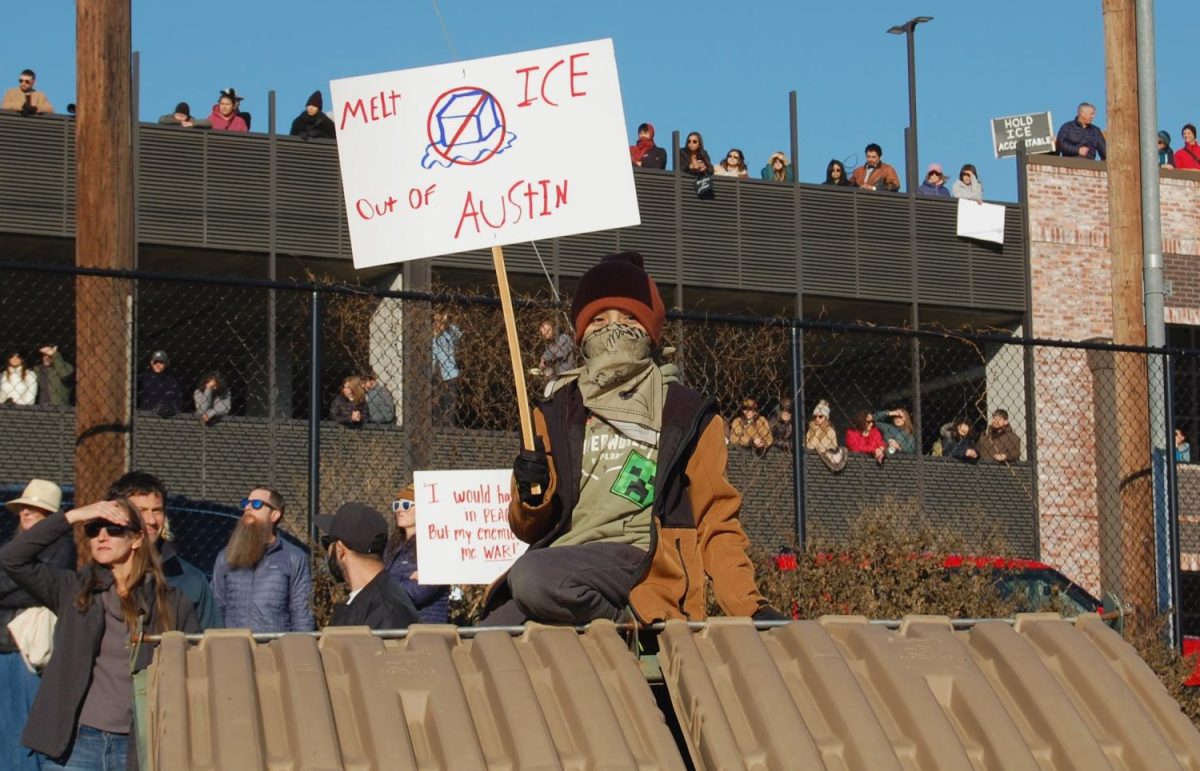

As community fears have risen over U.S. Immigration and Customs Enforcement operations in Austin, Austin Police Chief Lisa Davis faced open anger from attendees during a town hall at Govalle Elementary School Thursday. The forum intended to address concerns surrounding APD assisting ICE, but Davis and other panel members, including three City Council members, faced frequent outcry from a packed cafeteria of around 200 people.
Over the last year, the Trump administration has increased immigration enforcement to historic levels, resulting in the deaths of over 30 detainees, according to The Guardian, and two protestors in Minneapolis last month. White House Press Secretary Karoline Leavitt has justified the surge in raids as “essential to halting and reversing the invasion of illegal criminals“, despite 74% of the over 70,000 current detainees in ICE custody lacking any criminal record, according to TRAC, a nonprofit data gathering organization.
Austin’s large immigrant community, which made up 15% of its population in 2023, contains an estimated 205,000 non-citizens potentially at risk for deportation, according to the Vera Institute of Justice, a nonprofit research and policy organization.
In January, Austin police called ICE after encountering a Honduran mother and her 5-year-old child, a U.S. citizen, during a disturbance call, leading to the deportation of both to Honduras, according to the Austin American-Statesman. ICE had an administrative warrant out for their arrest over an immigration violation, but these types of warrants are posted internally within ICE and lack a judge’s signature, meaning local police are not legally required to follow up on them.
Davis addressed the mother and child’s arrest early into the event, saying that administrative warrants look similar to detainer requests made by ICE to local police, which ask that officers hold a person for an additional 48 hours after they would have been released. APD is required to follow these requests under Senate Bill 4, a state law passed in 2017 targeting “sanctuary city policies,” according to the bill’s text.
“The majority of officers are not calling ICE on administrative warrants,” Davis said.
Under a new policy Davis said she plans to institute, APD officers will still be allowed to contact ICE on administrative warrants, but commanders would decide if officers would wait for immigration agents to arrive.
“The priority is not waiting for ICE to respond on a civil detainer, so that will be taken out of the hands of the officer,” said Davis.
An attendee asked Davis directly if APD would actively collaborate on operations with I.C.E. She said that Austin Police would only take “reasonable” actions like blocking off traffic.
“We are not responding on operations with ICE and conducting those raids,” Davis clarified.
Davis said that although she held “personal feelings” about detainers, Senate Bill 4 forbade her from explicitly going against them under threat of removal as chief.
“There is a rule of law that I have to follow as the chief of police here in the state of Texas,” Davis said.
Robert Saulter, a public defender for Travis County and former criminal defense attorney in the military, criticized Davis’s statement saying that she should be willing to face removal if it meant doing the right thing.
“On several occasions, I was asked to do things that I thought were not ethically or morally correct, both in my time in the military and prior to that … I was willing to stand up for what I thought was right,” Saulter said. “Are you too much of a coward to be removed from your position?”
Another attendee questioned why officers were not trained on the difference between administrative warrants and detainers from the start.
“I am confused as to how y’all could not understand the difference and why your people were not trained,” the attendee said. “Every individual, every citizen, has to learn what this is, because they have to prevent people from breaking down their door and stealing their neighbors and their children.”
Faiz Baghezza, a Dell engineer who came to the forum, wanted more direct answers on how local police would protect Austinites from having their constitutional rights violated by ICE.
“We’ve seen on TV constitutional rights that have been clearly violated,” Baghezza said. “In those situations like that, I don’t think anybody has the opportunity to wait or to hold up a piece of paper and say, ‘Hey, don’t come in.’”
His concerns come after an internal ICE memo gave agents permission to arrest people without warrants, according to the New York Times, potentially violating the fourth amendment of the Constitution. In October 2025, reporting from ProPublica also found that over 170 U.S. citizens had been held by ICE with more than 20 being refused contact with their lawyers or family.
“I want to know what the position of the (department) is when the rights of those who fund them are not being respected,” Baghezza said. “What are they willing to do to help us, the citizens here, or do we have to protect ourselves?”